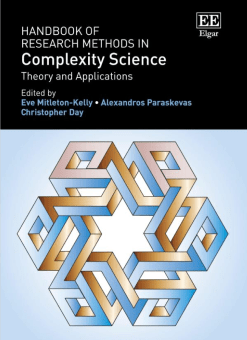
Delighted to announce the publication of my chapter in the newly minted Handbook of Research Methods in Complexity Science

Screen Shot 2018-02-03 at 12.56.18 PM

This comprehensive Handbook is aimed at both academic researchers and practitioners in the field of complexity science. The book’s 26 chapters, specially written by leading experts, provide in-depth coverage of research methods based on the sciences of complexity. The research methods presented are illustratively applied to practical cases and are readily accessible to researchers and decision makers alike.

Supporting jr. high school students in their study of global and public health issues

gale's kids_lily and meganFor the past few years I have had the pleasure of engaging with jr. high school students to support their study of global and public health issues.

For grade 7 students, they were addressing some rather profound questions regarding the differences in HIV spread and treatment in developed vs developing regions (specifically Africa). This is a summary of one of their projects.


Second publication this month in BMC Health Research Policy and Systems

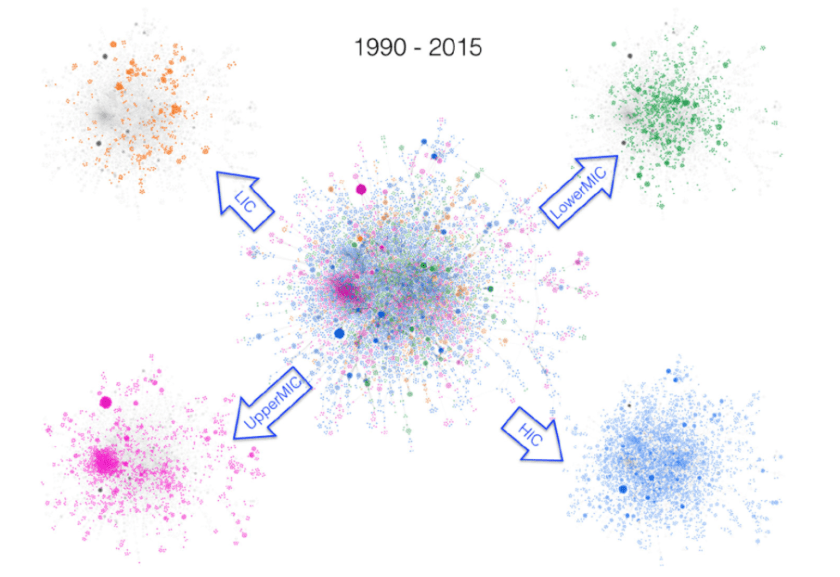
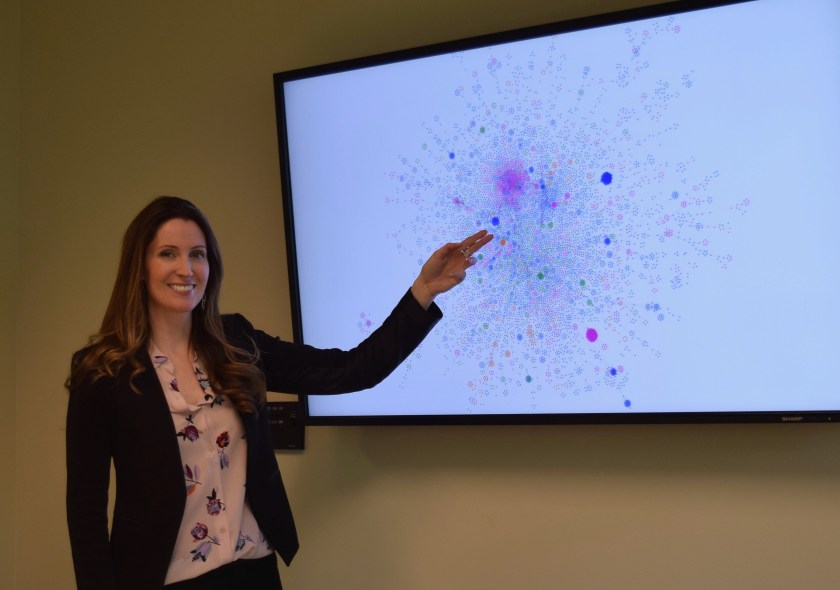
This paper, “Health Policy and Systems Research Collaboration Pathways: Lessons from a Network Science Analysis“, used network analysis to examine health policy and systems research (HPSR) bibliometric data. The results demonstrate the evolution in collaboration over time, among co-authors and their respective countries, by the World Bank’s economic classification.

During the early inception of HPSR, authors from high-income countries (HIC) were dominant and necessary to connect the network. In the 1990-2015 cumulative interval, authors from upper-middle-income countries (UpperMIC) became increasingly influential in HPSR. This emergent pattern has helped the UpperMIC shape the global structure of the HPSR co-authorship network, on par with HIC. More importantly, this emergent cluster acts as a hub to connect more authors from all economic regions
Screen Shot 2017-08-28 at 10.32.38 AM


Bibliometric analysis has found that the rate of participation in HPSR by LIC is out pacing all other economic regions

Since its inception, tremendous effort has been devoted to ensure health policy and systems research (HPSR) continues to support vulnerable populations and resource constrained regions through increased funding, institutional capacity building and knowledge production; yet, participation from the low- and middle-income countries (LMIC) is disproportionately underrepresented in HPSR knowledge production.

This analysis published in “Increasing Health Policy and Systems Research Capacity in Low- and Middle-Income Countries: Results from a Bibliometric Analysis” found that publication in HPSR has been increasing slowly and steadily since 1990. Publications that focus on LMIC-relevant issues, typically lag behind HPSR publications. In contrast to these modest progressions, first authors from LMICs have participated exponentially in the life and biomedical sciences (PubMed) since the early 2000s; and thus, while absolute numbers are still low, lead authors from low-income countries (LIC) outpace the publication growth rate in all other economic regions in HPSR. The increasing and meaningful participation by LMIC may be correlated to the expanded capacity in LMIC regions, due in part, to continued support of HPSR.


Screen Shot 2017-08-03 at 3.15.00 PM

SPPH researchers co-author chapter in WHO World Report on Health Systems

School of Population and Public Health researchers have co-authored a chapter in the first World Health Organization (WHO) World Report on Health Policy and Systems Research.

http://spph.ubc.ca/supporting-vulnerable-countries-with-research-spph-researchers-co-author-chapter-in-first-health-policy-report/

DSC_0052 edited

Congrats on your centennial UBC Alumni

So proud to be part of the UBC community – and of my brief cameo in their video.

https://www.alumni.ubc.ca/eBlast/misc/2017/alumniubc100-may4-web.html

fullsizeoutput_1512

On May 4, 1917, UBC’s Alumni Association was established – just one year after the convocation of UBC’s first graduating class. Today marks the launch of alumni UBC 100, a year-long celebration of the power of our global alumni community with the ambitious goal of making 100,000 alumni connections. Visit the new www.alumni.ubc.ca homepage to find out the many ways you can take part, wherever you are in the world! #WeAreOneUBC